

Custom Precision CNC Machined Forged Shaft In China: From Raw Ingot to Final Tolerance — A Full Process Guide

Phase 1: Metallurgical Selection and Ingot Thermal Preparation: Preventing Hydrogen-Induced Fissures
The manufacturing journey begins with strict raw material gatekeeping at the initial melting and casting stage. Engineering teams select premium carbon steel or specialized low-alloy formulations based on the specific operational demands of the final machinery. Common industrial choices include high-strength grades such as AISI 4130, AISI 4340, 42CrMo4, and specialized marine carbon steels. The raw material procurement specifications must enforce exceptionally low limits on harmful trace impurities like sulfur and phosphorus. Maintaining sulfur content below 0.010 percent prevents the formation of low-melting-point sulfide networks along the metal boundaries. Consequently, this clean steel chemistry eliminates microscopic non-metallic inclusion bands within the underlying crystalline matrix. Once the qualified ingot arrives at the production facility, technicians place the raw block inside digitized gas-fired heating furnaces. The thermal processing team configures slow, multi-stage heating profiles to elevate the ingot temperature to the optimal plastic deformation window. This precise thermal soaking allows the entire volume to achieve a completely uniform temperature profile from the surface to the core. Furthermore, thermodynamic homogenization eliminates internal thermal gradients that can induce catastrophic stress cracking before forging.
Phase 2: Deep-Penetration Open-Die Forging: Consolidating the Centerline and Refining Grain Morphologies
Hot mechanical deformation represents the physical core of the structural transformation process. The heated ingot transitions rapidly from the soaking furnaces to the heavy forging division to begin open-die processing. To consolidate the metal core effectively, the manufacturing facility utilizes large-scale, automated heavy industrial machinery. Massive open-die hydraulic press units deliver sufficient deep-penetration forging energy to deform the alloy thoroughly to its absolute centerline. This intense compressive force completely collapses natural casting voids, centerline porosity, and microscopic shrinkage cavities inside the ingot. Production technicians manage the forging reduction ratio with extreme care to guarantee absolute internal volumetric soundness. This heavy mechanical deformation breaks down the weak as-cast dendritic crystal formations into a dense, highly refined grain structure. Furthermore, skilled forge operators manipulate the billet under the press to align the continuous metallic grain flow lines parallel to the shaft's primary operational stress vectors. This careful directional control ensures that the finished marine shaft achieves exceptional resistance to dynamic torsional fatigue loads. Technicians pre-form the steps and journals near the net shape to maximize material yield.
Phase 3: Intermediate Machining and Phase-Change Heat Treatment: Maximizing Microstructural Homogeneity
Following the completion of hot forging, the raw shaft blank requires a rough machining stage prior to undergoing phase-change heat treatment. Heavy-duty turning lathes peel away the coarse, oxidized scale from the outer circumference of the forged block. This initial metal removal establishes precise geometric baselines and exposes clean metal for subsequent thermal processing. WUXI HONGDA HEAVY INDUSTRY CO., LTD then routes the rough-turned component to its specialized heat treatment division for microstructural optimization. The technical team configures precise vertical or horizontal austenitizing cycles inside calibrated thermal chambers. Next, automated overhead crane systems submerge the glowing shaft into advanced polymer or water-quenching agitation tanks. The highly controlled cooling rate transforms the microstructure into a uniform, fine-grained martensitic phase while minimizing internal residual stresses. This specialized polymer quenchant reduces the thermal gradient between the surface and center, preventing quench cracking. Immediately after quenching, the shaft enters a tempering furnace for an extended thermal soaking cycle. This vital tempering process relieves internal mechanical strains, establishing an optimal balance between high tensile strength and excellent sub-zero impact toughness.
Phase 4: Precision Multi-Axis CNC Machining: Conquering Dimensional Volatility for Final Tolerances
The quenched and tempered forging possesses exceptional mechanical properties, but the component still requires final precision shaping. To bridge this gap, the manufacturing floor deploys high-performance multi-axis computer numerical control turning centers. HONGDA HEAVY INDUSTRY(WUXI HONGDA HEAVY INDUSTRY CO., LTD) utilizes rigid CNC machining assets to execute the final metal removal phase with extreme accuracy. The automated cutting tools manage severe mechanical forces and tool-wear volatility effortlessly. Machinists utilize specialized stress-free clamping techniques to prevent structural spring-back or flexing between successive cutting passes. This advanced machining control produces exceptionally tight geometric tolerances on critical bearing journals, splines, and keyways. The final finish turning operations easily achieve sub-millimeter concentricity, strict cylindricity, and pristine surface roughness targets. Furthermore, live tooling capabilities allow the CNC centers to mill keyways and cut splines in a single mechanical setup. This unified approach maintains perfect coaxiality across the entire length of the component. Consequently, this precise digital control allows the finished mechanical shaft to slide into complex industrial gearboxes without manual adjustment. Perfect geometric execution minimizes rotational friction and extends the service life of downstream assemblies.
Phase 5: Comprehensive Volumetric and CMM Metrology: The Absolute Gatekeepers of Operational Safety
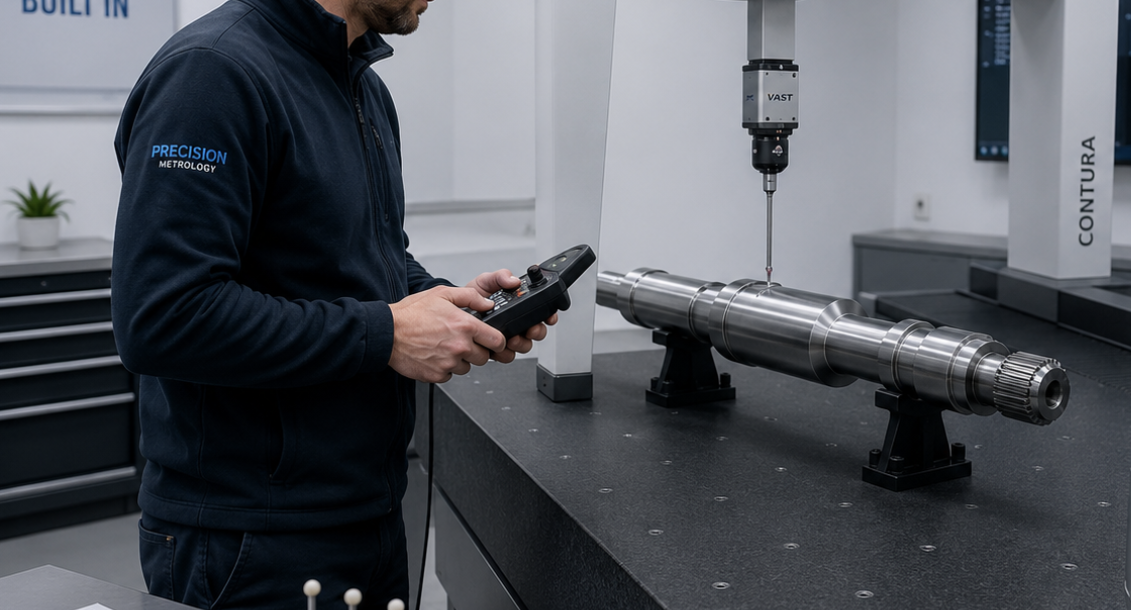
The final phase of the process guide focuses on absolute quality validation before global shipment occurs. Highly qualified quality control technicians execute comprehensive non-destructive testing protocols across the entire finished shaft volume. Inspectors utilize multi-channel Ultrasonic Testing and Magnetic Particle Testing to scan for subsurface flaws. This rigorous inspection follows strict international standards like ASTM A388 to ensure the highly stressed transmission zones contain zero microscopic cracks. Concurrently, metrology teams utilize large-scale Coordinate Measuring Machines and laser trackers to verify three-dimensional geometric compliance. The CMM equipment measures the finished shaft against original engineering blueprints to confirm final tolerances. This multi-layered validation framework guarantees that every custom precision component delivers predictable performance under extreme service conditions. HONGDA HEAVY INDUSTRY compiles these traceable test results into a comprehensive digital passport for the client. This transparent documentation pack simplifies regulatory audits and accelerates international class society certifications for marine shafts.
Conclusion
In summary, converting a raw steel ingot into a micron-precise mechanical asset requires a systematic approach to process engineering. Every manufacturing step must enforce strict thermodynamic, metallurgical, and geometric quality controls. Eliminating process fragmentation ensures that heavy marine and mechanical shafts achieve ultimate operational safety. Global heavy machinery builders can secure their supply chains by partnering with a full-process manufacturer. This integrated engineering collaboration minimizes procurement risks and shortens project schedules significantly. To evaluate complete manufacturing capabilities, explore custom shaft options, or request a technical consultation, please visit the official corporate portal at https://www.hongdaforge.com/.
HONGDA HEAVY INDUSTRY
HONGDA HEAVY INDUSTRY
Legal Disclaimer:
EIN Presswire provides this news content "as is" without warranty of any kind. We do not accept any responsibility or liability for the accuracy, content, images, videos, licenses, completeness, legality, or reliability of the information contained in this article. If you have any complaints or copyright issues related to this article, kindly contact the author above.
