

Pedestrian Entrance Control Systems Market to Reach US$3.4 Billion by 2033 with 7.8% CAGR
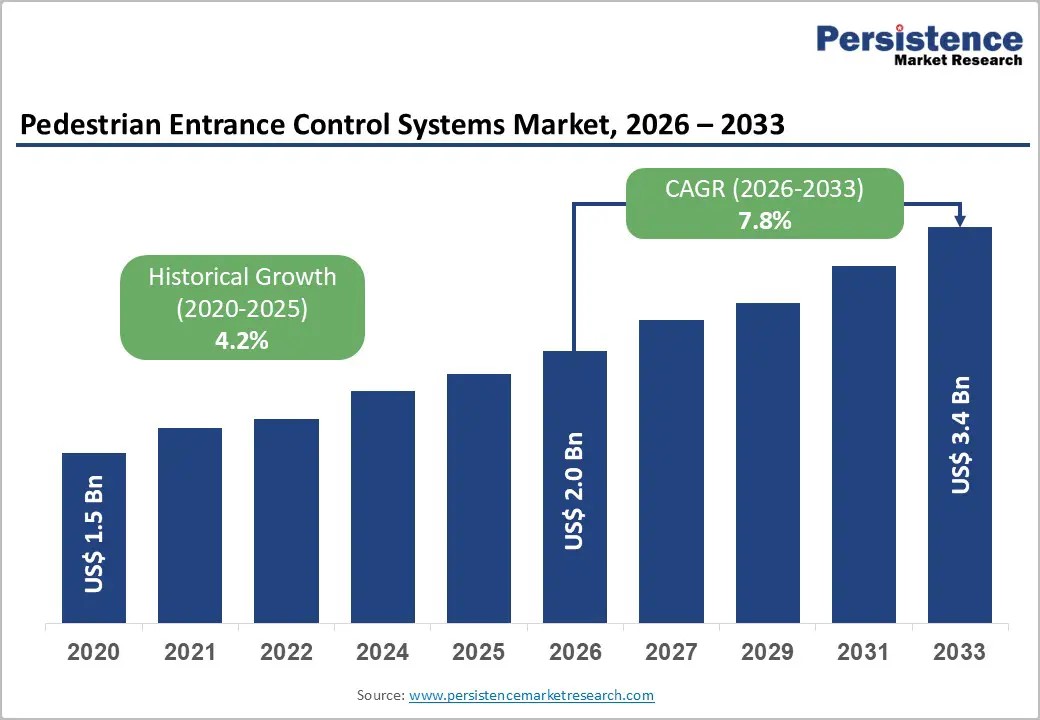
The pedestrian entrance control systems market is expected to grow from US$ 1.9B in 2025 to US$ 3.3B by 2032, at a CAGR of 7.8% during the forecast period
BRENTFORD, ENGLAND, UNITED KINGDOM, March 16, 2026 /EINPresswire.com/ -- Overview of the Market
The pedestrian entrance control systems market is experiencing consistent growth as organizations across the globe prioritize security, access management, and efficient movement of people in high-traffic facilities. The global market is projected to be valued at US$ 2.0 billion in 2026 and is expected to reach US$ 3.4 billion by 2033, expanding at a CAGR of 7.8% between 2026 and 2033. Rising security threats, increasing regulatory compliance requirements, and the growing adoption of biometric authentication and contactless access technologies are significantly driving demand for advanced entrance control systems.
These systems are widely deployed in commercial buildings, transportation hubs, government facilities, and critical infrastructure to regulate pedestrian access and prevent unauthorized entry. Among various segments, access control hardware such as turnstiles, speed gates, and security doors leads the market, accounting for a substantial share due to its foundational role in access control infrastructure. Regionally, Asia Pacific dominates the market with around 35% share, fueled by rapid urbanization, large-scale infrastructure projects, and growing investments in smart city security systems.
𝐆𝐞𝐭 𝐚 𝐒𝐚𝐦𝐩𝐥𝐞 𝐏𝐃𝐅 𝐁𝐫𝐨𝐜𝐡𝐮𝐫𝐞 𝐨𝐟 𝐭𝐡𝐞 𝐑𝐞𝐩𝐨𝐫𝐭: https://www.persistencemarketresearch.com/samples/22138
Market Segmentation
The pedestrian entrance control systems market can be segmented based on solution type, operation mode, and end-use verticals. In terms of solution type, the market includes access control hardware and access control software. Hardware components such as turnstiles, optical gates, speed gates, and security doors represent the largest segment as they serve as the primary physical barrier for regulating pedestrian movement. Turnstiles remain particularly popular in high-traffic environments due to their durability, efficiency, and proven effectiveness in preventing unauthorized access.
On the other hand, access control software platforms are the fastest-growing segment, supported by the increasing adoption of cloud-based solutions and mobile credential systems. These platforms enable centralized monitoring, advanced analytics, and real-time access management across multiple locations. In terms of operation mode, the market is divided into automatic and manual systems, where automatic systems dominate due to their ability to provide seamless, high-speed access control with minimal human intervention.
End-use industries further segment the market into commercial buildings, transportation hubs, government facilities, healthcare institutions, and industrial facilities. Commercial buildings hold the largest share due to growing demand for employee identification systems, visitor management, and asset protection. However, transportation hubs such as airports and metro stations are emerging as the fastest-growing application area as governments invest heavily in modern transit infrastructure.
𝐃𝐨 𝐘𝐨𝐮 𝐇𝐚𝐯𝐞 𝐀𝐧𝐲 𝐐𝐮𝐞𝐫𝐲 𝐎𝐫 𝐒𝐩𝐞𝐜𝐢𝐟𝐢𝐜 𝐑𝐞𝐪𝐮𝐢𝐫𝐞𝐦𝐞𝐧𝐭? 𝐑𝐞𝐪𝐮𝐞𝐬𝐭 𝐂𝐮𝐬𝐭𝐨𝐦𝐢𝐳𝐚𝐭𝐢𝐨𝐧 𝐨𝐟 𝐑𝐞𝐩𝐨𝐫𝐭: https://www.persistencemarketresearch.com/request-customization/22138
Regional Insights
Asia Pacific leads the global pedestrian entrance control systems market, accounting for approximately 35% of total revenue share. Rapid urbanization, expanding smart city initiatives, and massive investments in transportation infrastructure across countries such as China, Japan, and India are key growth drivers. The region also benefits from strong manufacturing capabilities and cost-effective technology development.
North America holds the second-largest share at around 28%, supported by stringent regulatory frameworks, advanced security infrastructure, and widespread adoption of integrated security solutions. The United States plays a crucial role in driving regional growth due to high investments in building automation, financial sector security, and critical infrastructure protection.
Market Drivers
Increasing global security concerns and the rising need for advanced access control solutions are major drivers for the pedestrian entrance control systems market. Governments, financial institutions, and commercial organizations are implementing sophisticated entrance control systems to protect sensitive data, assets, and personnel. These systems provide secure authentication mechanisms, detailed audit trails, and efficient monitoring capabilities, making them essential components of modern security infrastructure.
Another significant driver is the integration of biometric authentication technologies such as facial recognition, fingerprint scanning, and iris recognition. These technologies enhance accuracy and convenience while enabling touchless authentication. Additionally, the integration of mobile credentials through smartphones using NFC and Bluetooth technologies is improving user experience and accelerating market adoption.
Market Restraints
Despite strong growth potential, the market faces several challenges that may hinder adoption. One of the major restraints is the high capital investment required for deployment. Advanced pedestrian entrance control systems involve hardware installation, software integration, and system configuration, which can be costly for small and medium-sized organizations.
Another challenge is the complexity associated with integrating these systems with existing IT infrastructure and security networks. Retrofitting older buildings can also present structural limitations and operational disruptions. Moreover, ongoing maintenance and upgrade requirements increase the total cost of ownership over time.
Market Opportunities
The emergence of cloud-based unified security platforms is creating significant opportunities for market expansion. These platforms integrate access control, video surveillance, and analytics into a single ecosystem, enabling organizations to manage security operations more efficiently across multiple locations. Cloud technology also reduces upfront infrastructure costs and allows real-time monitoring and remote management.
Another promising opportunity lies in the growing adoption of mobile credentials and smartphone-based access systems. As organizations shift toward mobile-first environments, smartphone integration enables employees and visitors to access facilities without physical cards or keys. This trend is expected to transform access control infrastructure and drive the next wave of innovation in pedestrian entrance control systems.
𝐁𝐮𝐲 𝐍𝐨𝐰 𝐭𝐡𝐞 𝐃𝐞𝐭𝐚𝐢𝐥𝐞𝐝 𝐑𝐞𝐩𝐨𝐫𝐭: https://www.persistencemarketresearch.com/checkout/22138
Company Insights
Royal Boon Edam International B.V.
Dormakaba Holding
KONE Corporation
ZKTeco Co., Ltd.
Honeywell International Inc.
ASSA ABLOY Global Solutions
Johnson Controls International plc
PERCo
Neptune Automatic Pvt. Ltd.
Gunnebo Entrance Control
Hayward Turnstiles
Turnstile Security Systems Inc.
URSA Gates Ltd.
CAME Group
Magnetic Autocontrol
Recent Developments
• In December 2023, Honeywell announced the acquisition of Carrier Global Corporation’s Global Access Solutions business for US$ 4.95 billion, strengthening its building automation and security portfolio.
• In December 2023, ZKTeco partnered with Amazon Web Services (AWS) to launch the Minerva IoT platform, enabling secure and scalable cloud-based access control solutions.
Related Reports:
Pooja Gawai
Persistence Market Research
+1 646-878-6329
email us here
Visit us on social media:
LinkedIn
Instagram
Facebook
YouTube
Legal Disclaimer:
EIN Presswire provides this news content "as is" without warranty of any kind. We do not accept any responsibility or liability for the accuracy, content, images, videos, licenses, completeness, legality, or reliability of the information contained in this article. If you have any complaints or copyright issues related to this article, kindly contact the author above.
